
Most people think learning is about acquiring knowledge. In reality, learning is about moving through stages of awareness. Understanding that process changes how we approach skill, mistakes, and mastery. The Four Stages of Competence described by Noel Burch in the 1970s, explains the journey from not knowing a skill at all to performing it effortlessly.
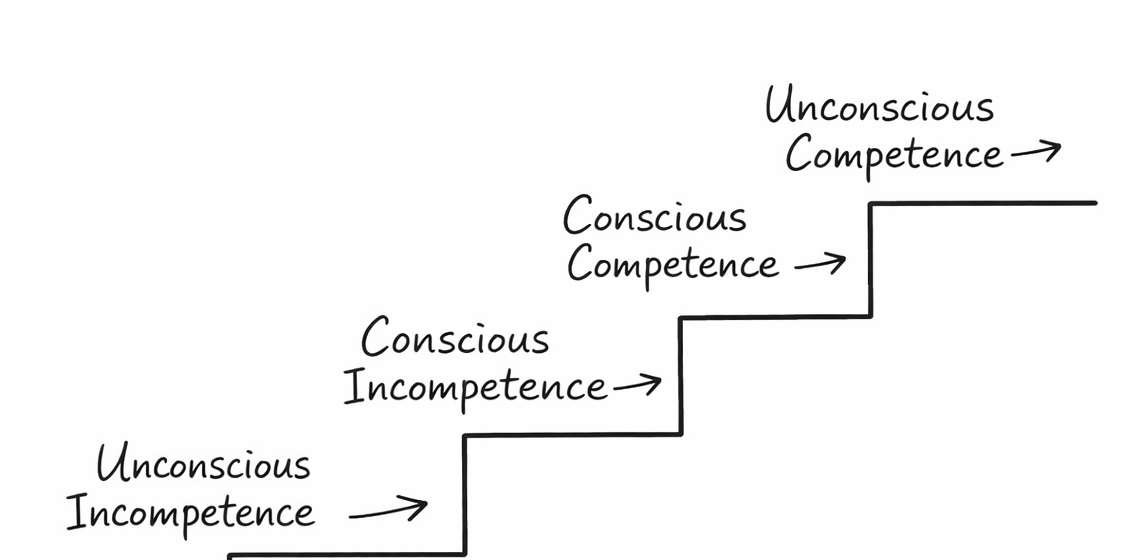
- The first stage is unconscious incompetence. At this point, we simply do not know what we do not know. There is no awareness of the gap. Many early career mistakes, business misjudgments, and failed experiments begin here. The individual is not yet able to see the terrain.
- The second stage is conscious incompetence. Awareness arrives. We now see the gap between our current ability and the required skill. This stage can be uncomfortable, but it is the beginning of real progress. The mind is forced to slow down, observe, and learn deliberately.
- With practice, we enter conscious competence. The skill can now be performed, but it requires attention. We think through each step. Errors still occur, but they are fewer because the mind is actively engaged in the process.
- The final stage is unconscious competence. This is where performance becomes natural. The mechanics of the task disappear from awareness. Actions become fluid, efficient, and reliable. We see this in everyday activities like, brushing our teeth, driving on a familiar route, typing on a keyboard. The body and mind simply execute. Because attention is no longer consumed by the mechanics of the task.
But mastery is not a permanent state. Even highly practiced skills occasionally produce errors. When that happens, the right response is not frustration but recalibration. The moment we notice something is off, we step back into conscious competence. We slow down, examine the mechanics, correct the mistake, and reinforce the fundamentals.
Once the adjustment is made, the skill returns to its natural state. It is again effortless, automatic, and reliable.
Learning therefore is not a ladder that we climb once. It is a cycle. Awareness leads to practice, practice leads to fluency, and fluency occasionally returns to awareness for refinement.
The people who improve the fastest understand this rhythm. They know when to operate instinctively, and when to pause, step back a level, and learn again. Over time, that discipline turns effort into instinct, and instinct into performance.